Introduction
Camaret-sur-Mer is a former major crayfish (spiny lobster) port, tucked away at the head of the cove of the same name, at the western tip of the Crozon peninsula. It is the last sheltered port of call before the open sea: Ushant (Ouessant), the Fromveur and the open ocean lie just beyond. For anyone learning to cruise in the Mer d’Iroise, Camaret is a natural stopping point — accessible in all weathers, rich in maritime history, and ideally placed for preparing a more demanding passage.
The setting is striking: the golden Vauban tower guarding the harbour entrance (a UNESCO World Heritage Site), the chapel of Notre-Dame de Rocamadour, and the famous boat graveyard, whose stranded hulls tell the story of the golden age of crayfish fishing.
Approach & anchorage
The approach is straightforward and well marked. You round the Pointe du Toulinguet and the Pointe du Grand Gouin before the Anse de Camaret opens up, exposed to the north-east but well protected from the prevailing westerly winds. The Sillon breakwater, on which the Vauban tower stands, encloses the harbour.
Practical notes — Beware of the Trépieds rocky plateau and the rocks off the Toulinguet in reduced visibility. The harbour remains accessible at all states of the tide. When approaching at night, the lights on the Sillon breakwater and at the entrance mark the way in.
Three options for the night:
- Le Notic marina — visitors’ pontoons, accessible at all states of the tide; the comfortable option for taking on water and charging the batteries.
- Port Vauban (the mole) — rafted-up berths along the historic breakwater, for those who prefer the atmosphere of the old harbour.
- At anchor in the cove — in settled westerly weather, good holding in sand and mud; to be avoided in a north-easterly wind.
Services ashore
Camaret is a fully equipped harbour, which makes it a valuable logistics stop in the middle of a course:
- Harbour office, water and electricity on the pontoons, fuel.
- Toilets, showers, launderette.
- Provisioning: shops, a bakery and a market in season, a few minutes’ walk away.
- Boatyard, chandler and repairers on site — handy for minor damage.
- Weather information and advice on the offshore approaches from the harbour office before heading for Ushant.
Things to see & do
The stop is worth taking the time to go ashore:
- The Vauban tower (built 1693–1696) — the architect’s model tower, a UNESCO World Heritage Site, a stone’s throw from the pontoons.
- The boat graveyard — the wrecks of the last crayfish boats, at the foot of the breakwater: a photogenic place, full of memories.
- The Lagatjar alignments — a megalithic site of standing stones, a short distance from the harbour.
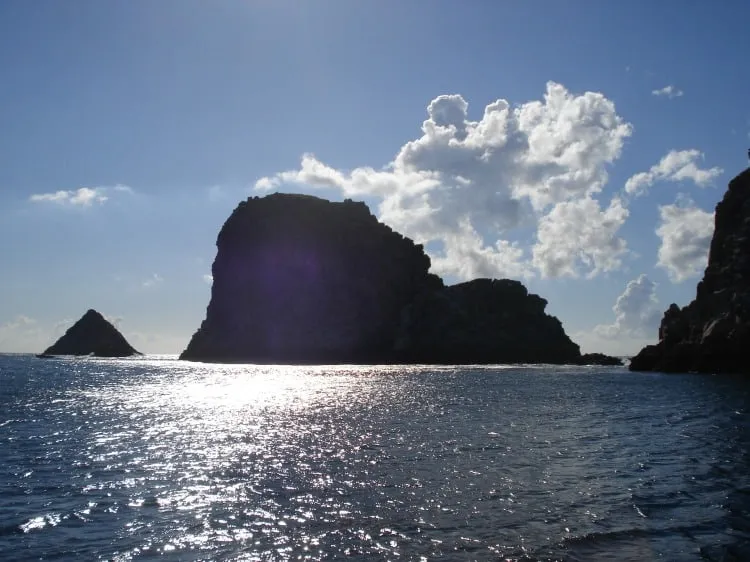
- The Pointe de Pen-Hir and the Pointe du Toulinguet — spectacular cliffs and the famous “Tas de Pois” rocks, reachable on foot or by bike.
- Local food — a chance to taste langoustines, abalone and the catch of the day in the harbour’s restaurants.
During the course — Camaret is also a training ground: berthing alongside a pontoon or quay, sometimes rafted up, anchoring in the open cove, and preparing a more exposed passage towards Ushant or the Rade de Brest. Here you work on reading the tidal streams of the Goulet and planning a passage in the Mer d’Iroise.
In pictures