The boats

Four cruiser-racers, all of them Bavaria Matches. Not a random choice: these are lively, well-rigged boats on which you feel every change of trim straight away — and they remain comfortable enough to live on board for a week.

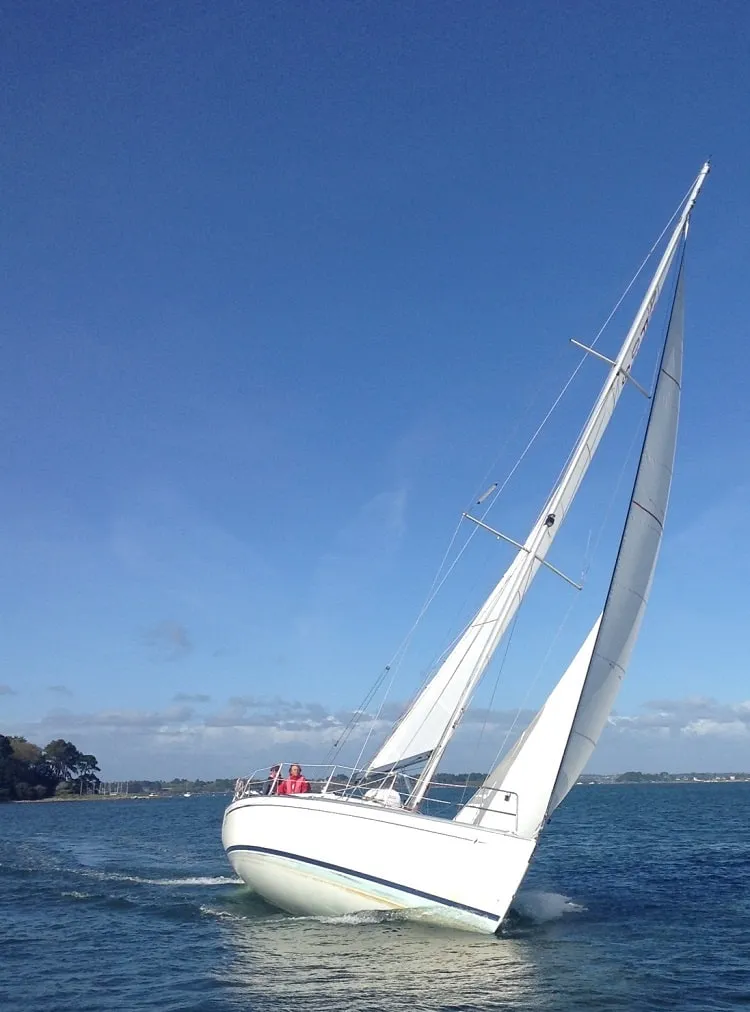
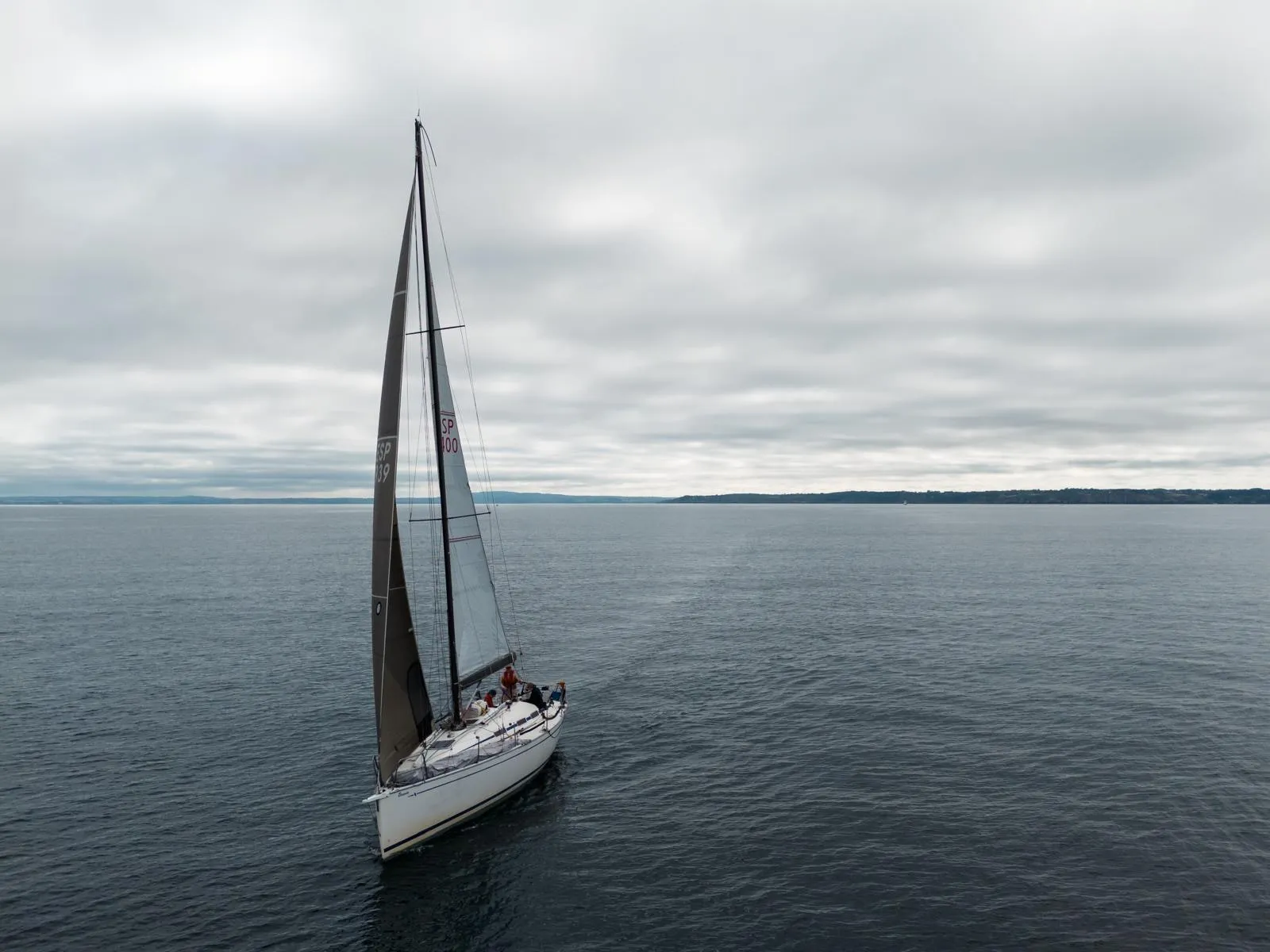
One of the school's yachts under sail, seen from the air
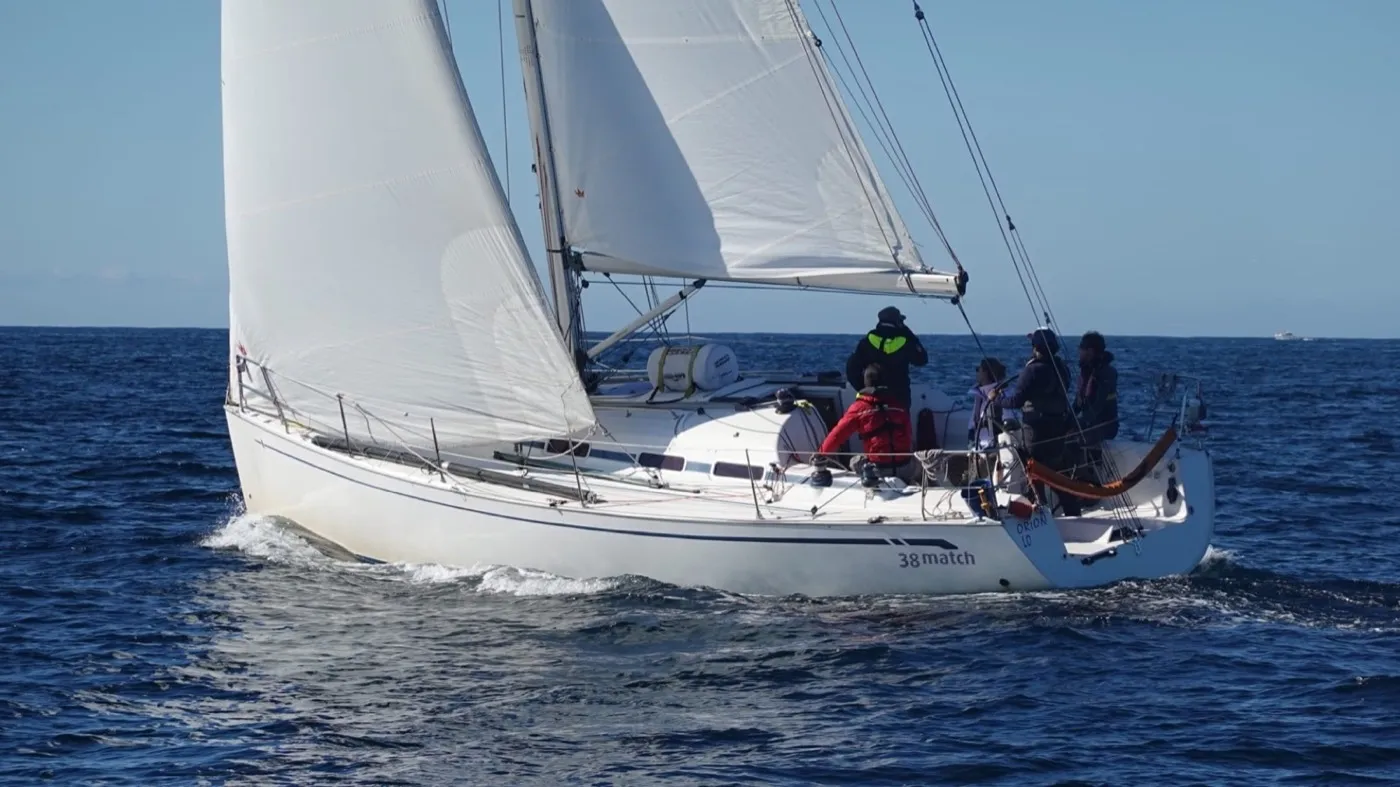
The yacht Orion under sail

Orion

Bavaria 38 Match 4 trainees Skipper: Gaëlle

Gaëlle is a fan of her boat: 2.35 m draught, a straight keel, real seakeeping qualities… Orion simply does everything very well.

Performance

  • Very quick on every point of sail, from hard on the wind to running under spinnaker
  • A yacht that is at once reassuring, very seaworthy and fast, even when loaded
  • At ease in light airs and heavy weather alike

Which courses

On board

  • Two large cabins
  • A large sail locker
  • An AIS transmitter
Inside Orion, a Bavaria 38 Match
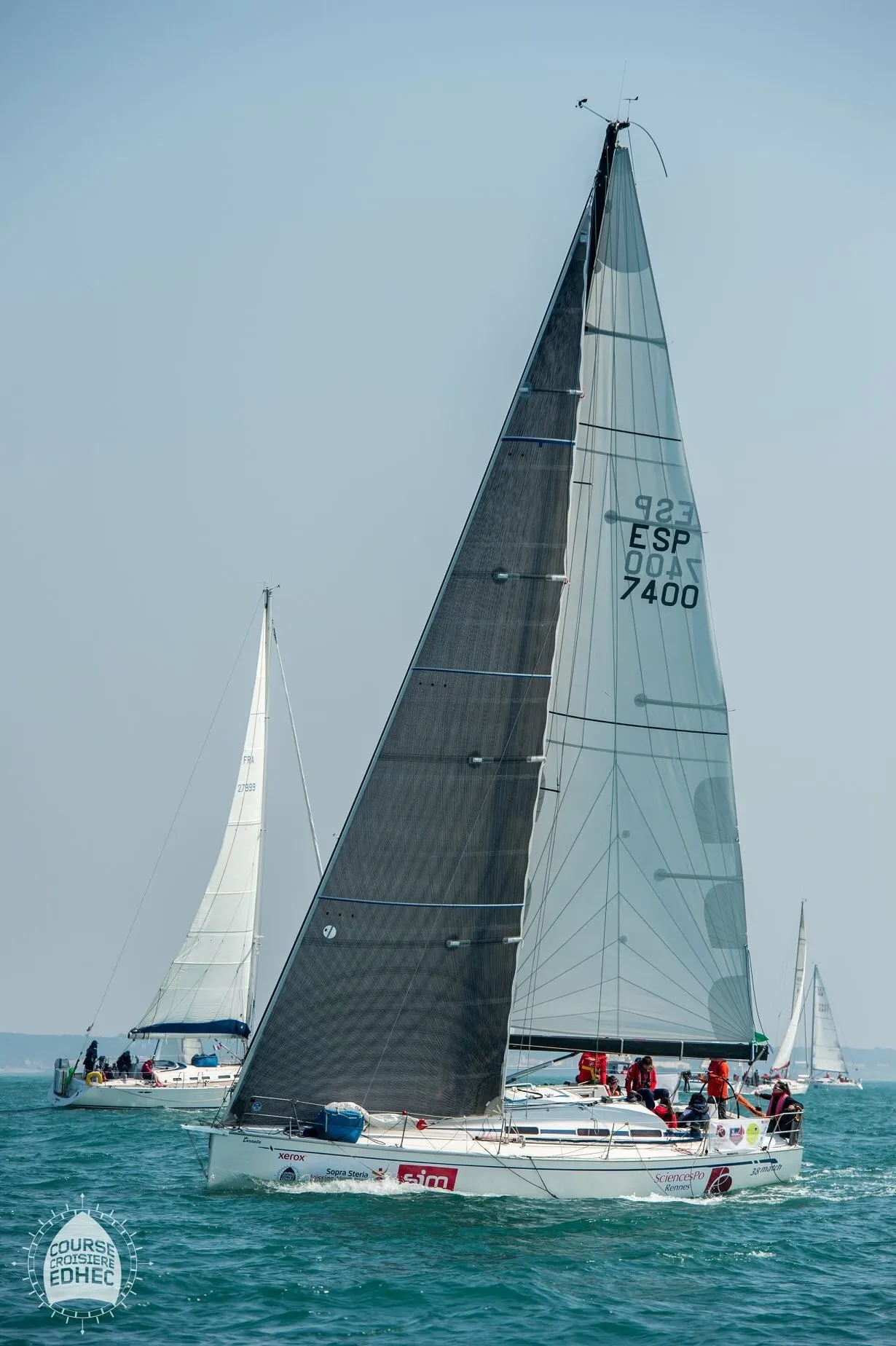
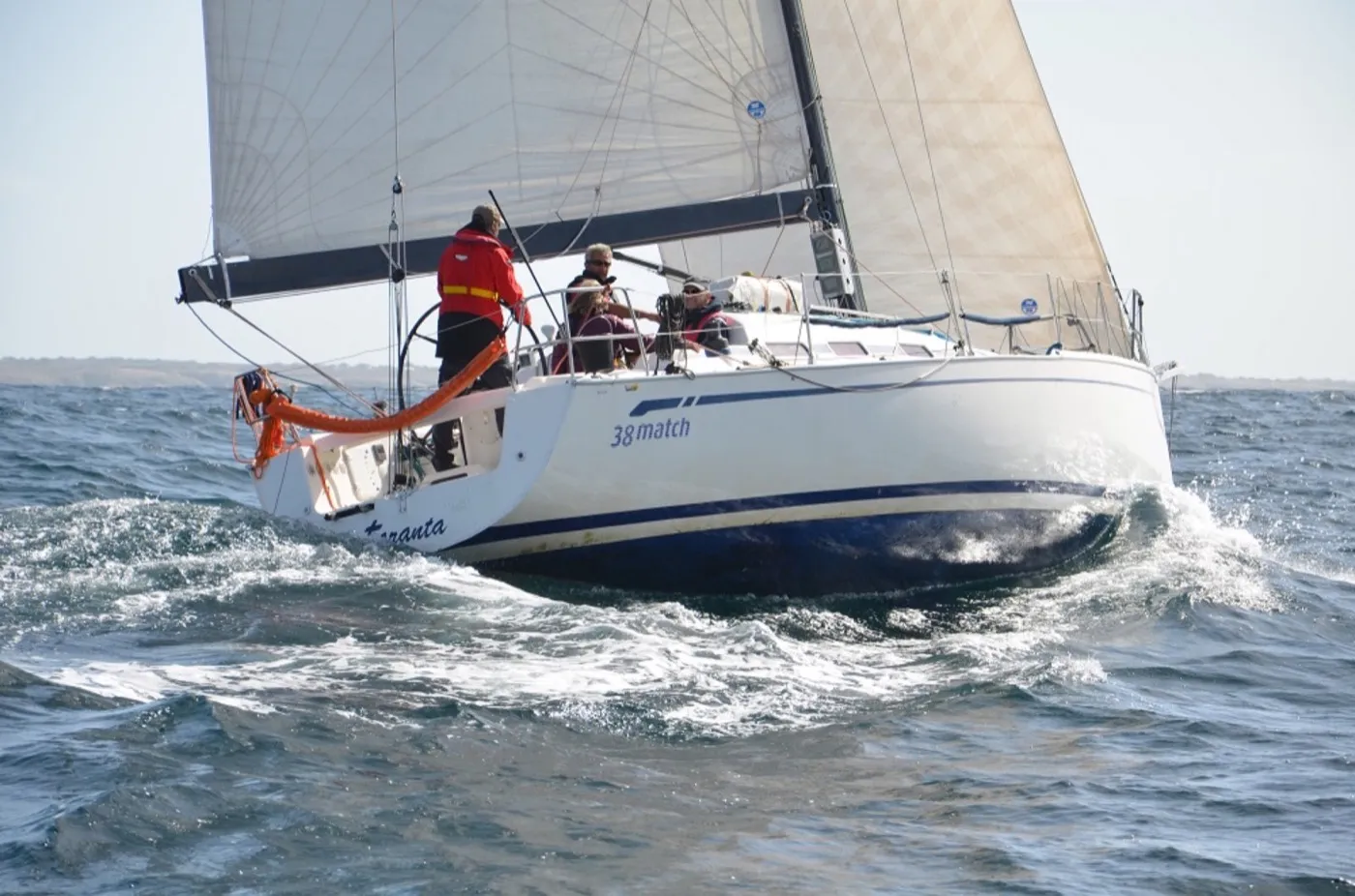
The yacht Taranta under sail

Taranta

Bavaria 38 Match 4 trainees Skipper: Loïck

A 38 Match rigged for performance: a tall carbon mast and an integrated bowsprit. Her draught is the same as Orion's: 2.35 m.

Performance

  • The taller mast makes her even quicker in light airs: to this day Taranta is a benchmark upwind in light weather, even when racing
  • The spinnaker goes up as soon as conditions allow

Which courses

On board

  • Two large cabins
  • A large sail locker
Taranta under asymmetric spinnaker
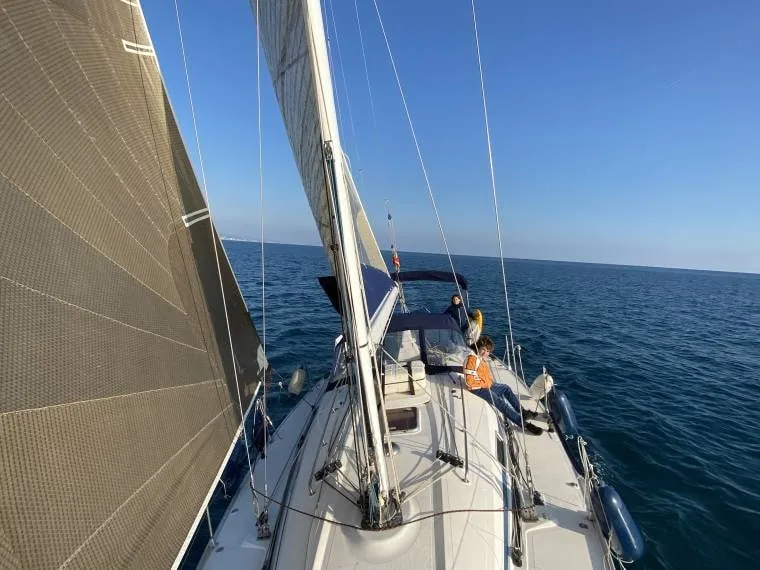
The yacht Perseus under sail

Perseus

Bavaria 42 Match up to 5 trainees Skipper: Boris

The largest and fastest boat in the fleet: the boat for the weeks when you come to log miles.

Performance

  • Straight keel with 2.45 m draught and a tall carbon mast
  • High average speed: she covers ground fast, a notch above the 38 Matches

Which courses

On board

  • Three fine cabins, real comfort at sea
  • The only boat in the fleet that takes five trainees
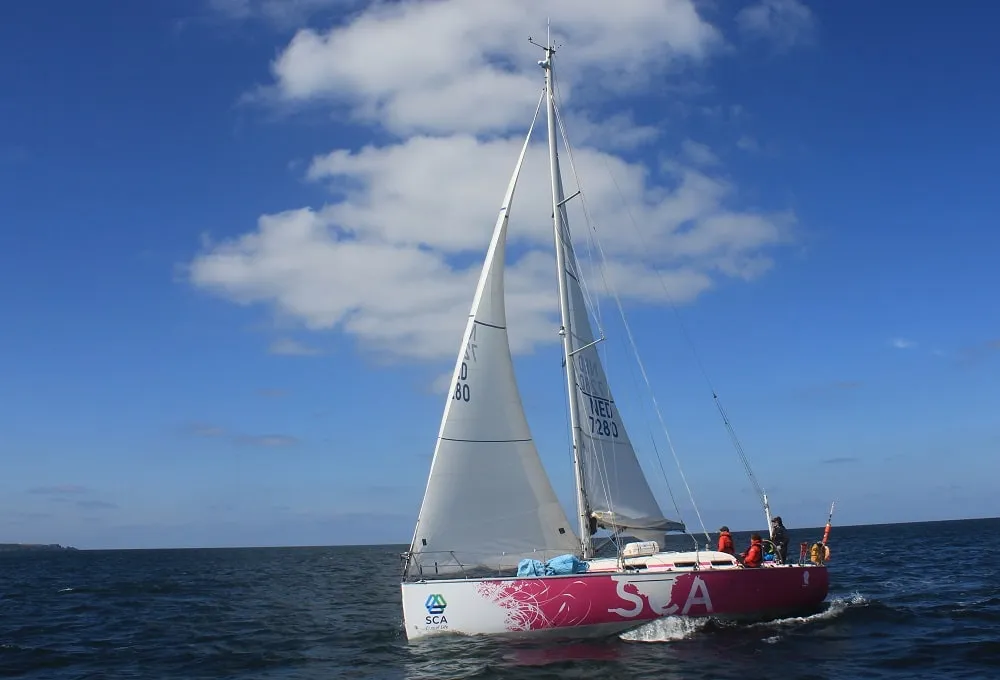
The yacht Grace O'Malley under sail

Grace O'Malley

Bavaria 38 Match 4 trainees (up to 8 people on board for charter)

With her 2.2 m draught and bulb keel, she does everything (very) well: easy to handle under engine as under sail, and quick in all conditions.

Performance

  • Slightly less good upwind than Orion and Taranta, but she makes up for it with excellent stiffness
  • Always very popular, even offshore

Which courses

On board

  • Three-cabin version, much appreciated for flotilla charter and skipper training
Why these boats

Cruiser-racers, not charter boats

A sluggish boat teaches you nothing: trim the sails any old way and she sails just the same. On a Match, poor trim shows up at once on the log and you feel it on the helm. That is what makes progress fast, even for a beginner.

The Bavaria Matches belong to the cruiser-racer family: more sail area, a deeper keel, a larger cockpit designed for manoeuvring, more complete deck hardware (bigger winches, more trim controls, mainsheet traveller in the cockpit). The interior volume is noticeably smaller than that of a cruiser of the same length; the quality of the fit-out, on the other hand, is the same.

The crew is deliberately kept small: four trainees per boat, five on Perseus or for a group booking together. Everyone helms, everyone handles the boat, nobody just watches.

No roller furling on board: each boat carries several headsails, one for each wind strength, so we can go out in very varied conditions — from a light breeze to the solid forty knots that Brittany sometimes serves up without warning.

Performance

What is a cruiser-racer?

Cruiser-racers bring together the best of racing yachts and the best of cruising yachts.

A few figures to put their performance in context. They are given as racing handicaps under the French sailing federation's Osiris rating (FFV), the figure used to compare boats in a race: the higher it is, the faster the boat.

  • Compared with a cruiser: a Bavaria 38 Match has an average sailing speed equal to or higher than that of a cruiser of over 47 feet. Example: the Oceanis 473 (14.15 m) has a handicap of 27.5 in the deep-draught version and 28.5 in the “performance” version — which is also the racing handicap of the 38 Match.
  • Compared with a racing yacht: her performance is comparable to that of a 35-foot racing yacht. Example: the A35 (10.59 m, against 11.39 m for the 38 Match) has a raw Osiris handicap of 28.5.
  • In knots: this handicap corresponds to an average speed of 5.7 knots observed in races.

In short, a 38 Match performs much like a racing yacht less than a metre shorter (with very little comfort) and like a cruiser 3 m longer.

And compared with offshore racing yachts?

Upwind in light airs, our boats can be quicker than Figaro 3s. But offshore racing yachts are another world: generally far higher performance, from very high-tech, very stiff, often violent boats that can suffer breakages because of their high average speeds.

Upkeep

How do our boats age?

Our boats date from 2004. In the mid-2000s, yards turned away from quality joinery such as mahogany, which our Bavaria Matches are fitted with.

Unlike (coastal) cruising yachts, our boats have a very stiff structure — a stainless-steel frame, similar to that of X-Yachts — that keeps flexing to a minimum, even in tough conditions (close-hauled in a rough sea). This stiffness makes for performance, and also means the boats age well.

When the Match range was launched, Bavaria had under-dimensioned the keel attachment on the 38 and 42 Match. After a serious incident, and without acknowledging that there was a problem, Bavaria had oversized stainless-steel reinforcement plates fitted. There is therefore no perceptible ageing at that point. On Bénéteau's First range, by contrast, this is something that deserves close attention.

Boats with wide hulls — especially wide forward, as is the current trend — and flatter bottoms slam more and punish their structure, all the more so when motoring into the waves. The Bavaria Matches strike an excellent compromise: a fine entry and a rounded forefoot to get through a short chop without slamming too much, then a flatter area around the keel that allows bursts of extra speed: surfing downwind in a swell (our in-house records are over 16 knots).

What our boats don't have, and why:

  • No twin rudders: this set-up only makes sense on sporty racing or offshore racing boats; on a coastal cruiser it has almost nothing but drawbacks. So on our boats there are no rudder alignment issues and no complex mechanics.
  • No twin wheels: one more complication, which also brings more problems.
  • No bow thruster: a needless piece of kit up to 42 feet, which slows the boat down, brings problems of its own and often fails just when you really need it.
  • No roller furling: a handy invention, useful for some sailors and some sizes of boat. But when it jams, or when the headsail has been left up in a strong blow, the damage to the partly furled sail is usually serious.

Needless to say, we take great care over the upkeep of our boats, especially the joinery, which does a lot for the quality of life on board.
Comparison

The Bavaria Matches against recent boats

Surprisingly, more recent boats designed for the same kind of sailing perform much the same overall. They are simply a little quicker off the wind (more “fun”), thanks mainly to asymmetric spinnakers and slightly more planing hulls; but their efficiency at working to windward or running deep downwind (VMG) can be slightly below that of the 38 Match.

It feels as though an optimum was reached with these boats, and that newer designs mostly move the cursor around: what you gain in one place, you lose in another. In short, looking at recent cruiser-racers, we see no real added value.

The table below compares the VMG in figures: upwind, Perseus and Taranta have the best VMG in the comparison; downwind, the recent boats have a slight edge.

Upwind VMG: speed (in knots) at which you close on a point dead upwind.
BoatTrue wind (knots)Total
468101214162024
Orion 2.383.434.224.795.185.385.475.525.47 41.84
Grace O'Malley 2.353.364.074.635.075.295.385.425.38 40.95
Taranta 2.593.684.475.005.285.415.495.575.52 43.01
Perseus (42 Match) 2.483.564.374.975.335.495.585.665.64 43.08
Salona 380 2.363.404.164.725.095.275.365.415.35 41.12
Dehler 38 (2013) 2.463.504.284.855.205.365.445.515.46 42.06
Grand Soleil 37 2.463.284.004.574.995.175.245.315.04 40.06
X-37 Sport 2.523.574.344.885.165.285.355.415.35 41.86
Nouveau First 36 2.483.564.324.724.874.944.974.924.60 39.38
Downwind VMG: speed (in knots) at which you close on a point dead downwind.
BoatTrue wind (knots)Total
468101214162024
Orion 2.293.434.435.316.076.727.248.018.72 52.22
Grace O'Malley 2.293.494.445.266.016.667.257.978.68 52.05
Taranta 2.433.604.635.516.276.917.408.178.94 53.86
Perseus (42 Match) 2.503.684.725.646.457.107.638.459.29 55.46
Salona 380 2.653.854.865.736.396.857.267.958.83 54.37
Dehler 38 (2013) 2.563.734.755.646.437.057.548.319.10 55.11
Grand Soleil 37 2.553.714.685.546.306.917.428.158.90 54.16
X-37 Sport 2.553.734.745.626.376.967.438.178.97 54.54
Sun Fast 3600 2.623.824.835.706.356.807.197.959.61 54.87
Nouveau First 36 2.603.924.985.906.577.007.458.6610.84 57.92

Source: Loïck’s calculations from the ORC rating certificates, for example Taranta’s 2026 ORC certificate (PDF). (our boats in bold)

Fancy coming aboard?

Tell us your level and your dates — we will suggest the boat and the week that suit you.

See dates & prices How to get here