The basic technical terms
Before you trim, you need to name things. A few verbs and words come up all the time on board:
- Sheeting in a sail means pulling on a sheet to close the angle between the sail and the boat's centreline.
- Easing means letting a sheet out to open that angle. For any other line on board, “easing” means letting it out, giving slack: you can ease a mooring line, a halyard…
- Tensioning hard (bowsing down) means pulling a halyard or a clew adjustment very tight.
- Telltales are short strands of wool stuck to the sailcloth. They show you how the wind is flowing over the sail. They are fitted to the headsails and to the mainsail.
- The leech line is a thin line running from the head to the clew; when tensioned, it stops the leech of the sail from fluttering.
Points of sail
Learning the points of sail is necessary to find your bearings relative to the wind, but in practice they are of little use for trimming the sails. A beam reach or a broad reach can call for completely different trim depending on the boat's speed.
A gentle cruising yacht will sail on a beam reach with the sail well eased (open); a racing catamaran, in the same wind and on the same heading, will sail on a beam reach with the sail sheeted right in — because it is doing 30 knots while the cruiser does 5. The “by point of sail” trim settings shown in the classic diagrams therefore only hold for a sailing boat moving slowly. It is good to know them, but also to know their limits.
Apparent wind: what wind is really blowing into the sails?
The wind that actually blows over any moving object is called the apparent wind. It is the resultant of the true wind and the wind created by the boat's own motion, the boat-speed wind. Cycling at 20 km/h on a windless day creates a 20 km/h headwind: that is boat-speed wind.
You will notice that the apparent wind moves forward and strengthens. The faster the boat goes, the stronger the boat-speed wind, and the more the apparent wind strengthens and moves forward: you then need to sheet in harder than on a slower boat.
Upwind and downwind
When you go from a beam reach to close-hauled, the apparent wind moves forward and strengthens; there comes a point where the boat loses speed, because it is fighting the waves and the angle of the sails becomes too unfavourable. Upwind, you generally need a fast sail with little power, one that just deflects the wind. As you get closer to a dead run, the apparent wind is lighter and comes more from the side: you are at the limit of laminar flow. Downwind, you need a powerful sail.
Lift & airflow
All foils (sails, aircraft wings, rudder, keel…) moving through a fluid (water or air) use the flow to create lift. Lift is a kind of “suction”: it lets aircraft fly, stops sailing boats from making leeway (thanks to the keel or centreboard) and lets the sail “pull” the boat forward.
It is the pressure difference between the two sides of the sail, caused by the different flow of air over each side, that creates lift — a force with a component pointing forward. For this to work, the wind must be only just deflected by the sail: that is the condition for laminar flow.
Sheet trim
The sheet sets the sail's angle of attack to the wind, and therefore how far open it is relative to the boat's centreline. The basic principle never to lose sight of: a sail should be sheeted in just to the point where it stops luffing (this principle no longer applies between a broad reach and a dead run).
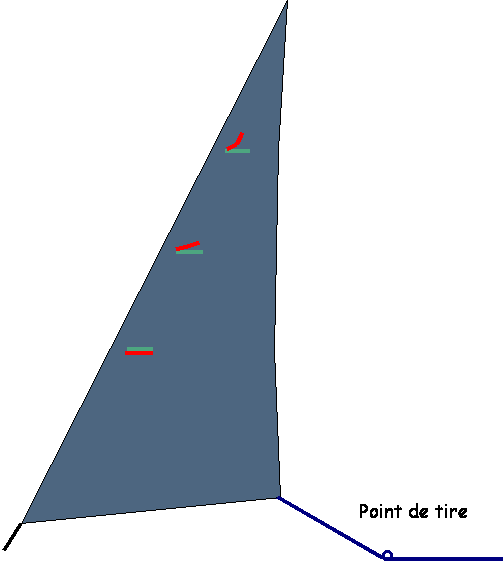
To find this setting, start with the sail luffing; as you sheet in, the sail fills first at the back, then the filled area spreads forward. When the sail is completely full, the trim is correct. The trim is perfect when the telltales on the windward and leeward sides both stream horizontally.
- The inside (windward) telltale stalls → sheet in slightly (or bear away if the sail is already sheeted in fully).
- The outside (leeward) telltale lifts and points forward, eddies form behind the sail → the sail is over-sheeted, there is no more laminar flow and no more lift: ease gently.
- Both telltales droop → the sail is deflecting the wind far too much and simply blocking it: ease well out (normal on a dead run).
This is the classic learning tool: you read the telltales placed near the luff, one on each side. By convention, the red telltale is on the port side and the green one on the starboard side. In the diagram below the boat is on port tack: red is to windward, green to leeward.
Halyard tension
Halyard tension controls the position of the draft in the sail (the same effects for the mainsail and the headsail):
- Too little tension: horizontal creases appear when you sheet in. On a sail with luff slides, in a strong breeze this setting can tear the cloth at the eyelets or break the slides.
- Too much tension: vertical creases remain along the luff even when the sail is full. Careful: never tension the headsail halyard on a slack forestay, it damages the sail.
- Light tension (light wind): the draft moves aft to around 50 %, the sail gives maximum power; it also fines the leading edge and lets you point higher in light airs.
- Strong tension (more wind, or when sailing closer to the wind in a medium breeze): the draft is pulled forward and held there, the sail loses power.
Genoa trim & the sheet lead
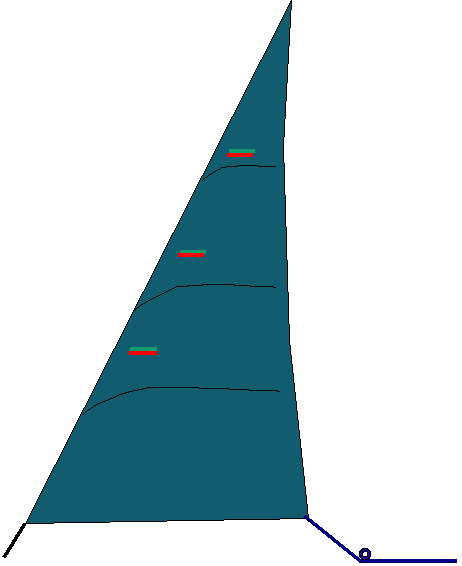
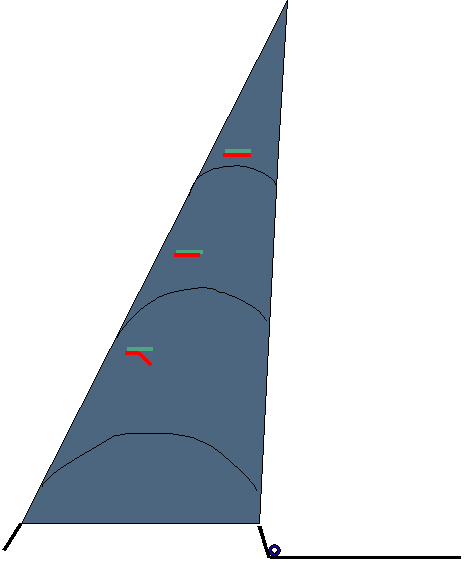
For headsails (genoa, jib, solent, storm jib…), a sheet lead — one on each side of the boat — consists of a track and a car; it sets the angle at which the sheet pulls on the clew of the sail, and therefore the twist of the leech.
- Car moved aft: the pull is more horizontal, the leech “opens”, the upper inside telltales stall. A good setting to spill excess power; otherwise the sail is over-twisted.
- Intermediate position: the ideal twist to get the most out of the wind.
- Sheet lead far forward: the pull is very vertical, the leech closes up completely and no longer lets the wind out, and the foot becomes very full. Use it sparingly, when bearing away. To go further, you rig a “short sheet”, which lets you move the clew sideways — but that is best learned on a course!
The backstay
The backstay is a wire that pulls the masthead aft. Its effect on the mainsail is twofold: by bending the mast, it opens the leech (the distance from head to clew shortens, the leech relaxes) and it flattens the luff in the middle section (the cloth is stretched). Two useful effects when you want a sail with little power: an open leech and a flat sail.
On the headsail, backstay tension is decisive: upwind you want a stable headsail with a fine leading edge, which a tight backstay gives you. With the backstay slack, the forestay is soft and sags to leeward — easy to see when you watch a sailing boat coming towards you.
The mainsail: outhaul, traveller & kicker
Outhaul tension
The outhaul sets the draft of the mainsail in its lower third. Outhaul eased: a powerful sail, useful on downwind points of sail in light to moderate wind. Outhaul tight: a flatter sail that deflects the wind less, and is therefore faster — suited to points of sail close to the wind, and downwind when the wind picks up.
The traveller & the kicker
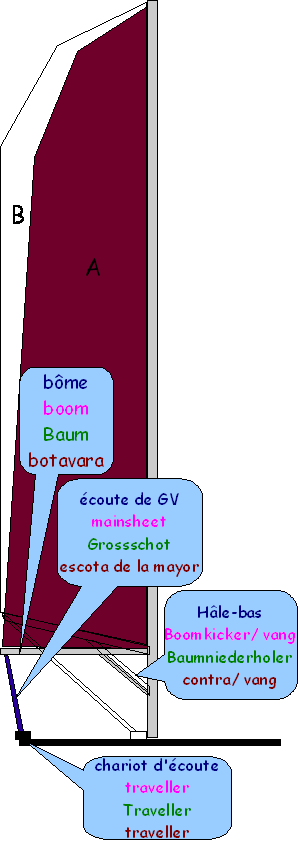
The kicker (boom vang) connects the boom to the foot of the mast and pulls it down; the mainsheet car slides along the traveller track. Both are there to hold the boom down or let it rise, and therefore to act on the twist of the leech. It makes sense to use them together: upwind, the kicker takes some of the load off the sheet; downwind, it is the kicker that stops the boom from rising.
- Car close to directly below the boom: vertical pull, the boom does not rise, the leech closes (possible on points of sail close to close-hauled).
- Car pulled up to windward, kicker eased: the boom rises, the leech opens and twists.
- With a large traveller fitted in the cockpit, you can quickly open the sail plan in a gust, then sheet back in once the gust has passed.
Twist: when should the mainsail be twisted?
The traveller position sets the twist of the sail: traveller right under the clew, little twist; traveller well away from the clew (pulled to windward, for instance), a lot of twist. As you bear away and ease the sheet, only the kicker still stops the boom from rising.
- Some twist is always needed: the wind is stronger aloft than at deck level, so the share of true wind in the apparent wind is greater up there, and the wind comes from further abeam.
- A sail with little twist is powerful but unforgiving: suited to light to moderate winds on flat water, or to fairly strong winds off the wind.
- A well-twisted sail suits gusty winds or a somewhat confused sea: its profile is more forgiving.
Putting it into practice
Close-hauled, medium wind, fairly calm sea: you want a fast mainsail, and therefore one with little power. In order:
- The backstay comes first (the stronger the wind, the harder it is tensioned): it flattens the luff and opens the leech.
- The halyard: tension set so that there are neither vertical nor horizontal creases; fairly high when close-hauled in a medium breeze.
- The outhaul is taken up (tight) for a fast sail.
- The sheet: sheeted in so that the boom is close to the centreline; think of sheet and car as a pair (the more you sheet in, the more you close the leech).
- The mainsheet car: set so that the leech telltales stream horizontally, the top telltale curling behind the sail 50 % of the time, top batten parallel to the boom.
- The kicker supports the sheet / car pair.
If the wind drops: take some tension off the halyard (the draft moves aft, the leading edge gets finer), ease a few centimetres of backstay, move the genoa sheet lead forward a little. If the wind picks up: add halyard tension, tighten the backstay, tension the leech line if needed, play the gusts with the traveller: drop it to leeward in the gust, pull it back up between gusts, move the genoa sheet lead aft.
The traveller follows the apparent wind. As a general rule, you use the traveller to follow changes in wind strength and in the angle of the apparent wind. In a gust, the wind is not only stronger, the apparent wind also comes more from abeam: you ease the traveller. After the gust it is the other way round: the true wind drops while the boat has picked up speed, the apparent wind moves forward again, and you pull the traveller back up. Close-hauled with full main (no reef), you can also pull the traveller up a little to twist the top of the sail: you spill wind and gain height. This no longer works with a reef, or once you are off a close-hauled course. A traveller you can really work only exists on cruiser-racers and racing yachts.
Downwind, in turbulent flow: ease the backstay (always keep some on!), the halyards, the outhaul (to add draft and power) and the leech line. The kicker depends on the state of the sea: tight to stabilise the sail, slightly eased in light wind with waves so the sail can breathe, and tight in strong wind, where it acts as a safety valve — releasing it is often the only way to spill a big overload of power, especially under spinnaker.
The spinnaker & sailing under spinnaker
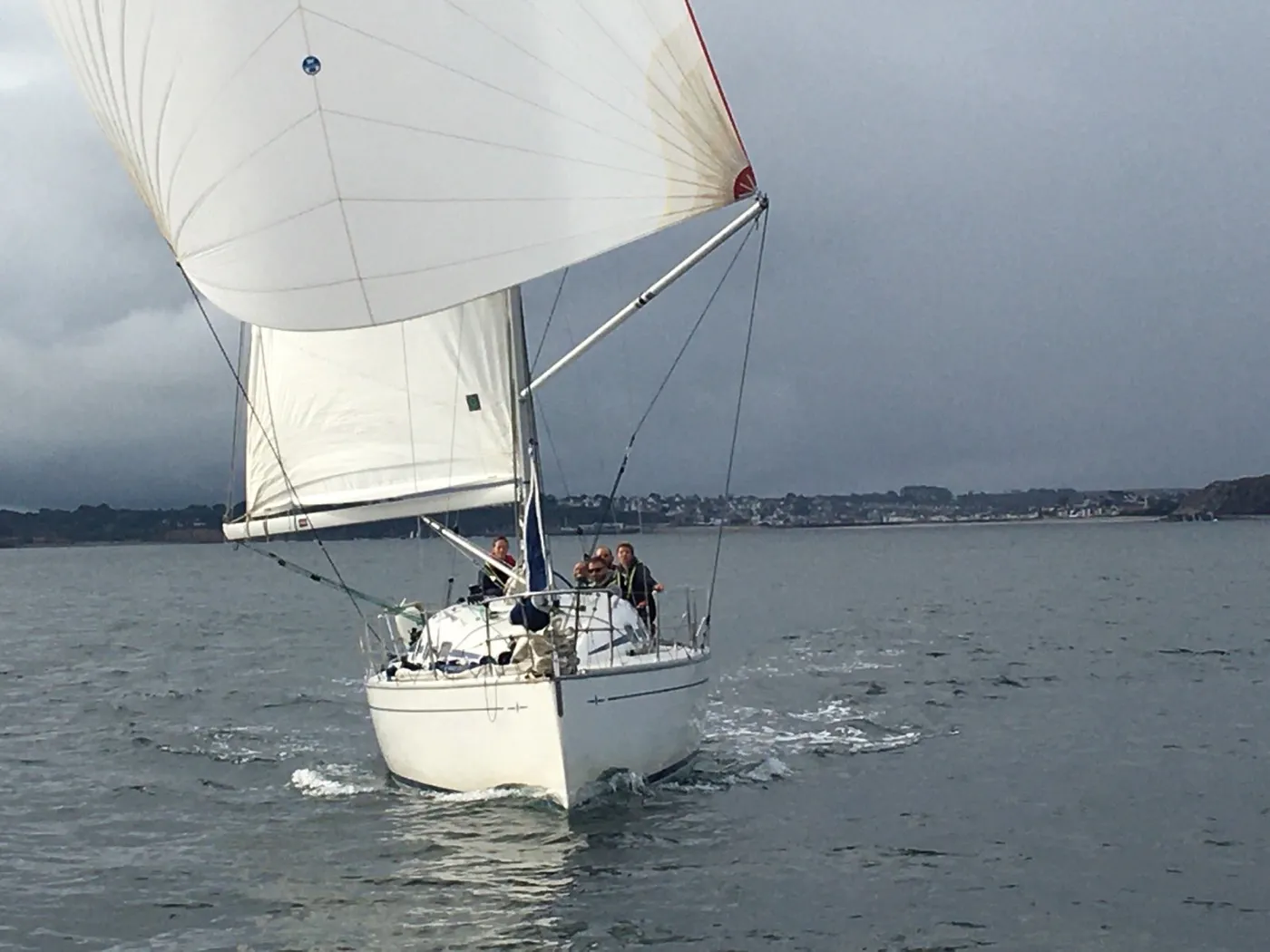
Squaring the pole means trimming in the guy (pulling the pole aft); easing the pole forward means letting out the guy (letting the pole go forward). Basic principles:
- The pole is set at right angles to the apparent wind.
- Tack and clew as close as possible to the same height; the clew must never be lower than the tack.
- The vertical centre seam of the spinnaker should stay parallel to the mast; the pole, if possible, horizontal, to hold the spinnaker away from the mainsail.
- The sheet is eased as far as possible, until a 20 to 40 cm curl appears in the luff.
- Lower the pole in light wind (a fuller, more powerful spinnaker); let it rise in medium wind; in strong wind there are two schools of thought: raise it to flatten the top of the spinnaker, or lower it to bring the centre of effort down.
Without a dedicated trimmer, it is up to the helm to keep the spinnaker drawing: if the luff curls, bear away slightly or sheet in a little; if the leech collapses (spinnaker blanketed by the mainsail), head up or square the pole. Communication between helm and trimmers is essential: too much pressure on the helm, square the pole further and ease the sheet; not enough, with a risk of broaching to leeward, ease the pole forward and sheet in.
Avoiding a broach and a death roll
Under spinnaker in wind and waves, communication between the helm and the trimmers is decisive: the helmsman passes on what he feels through the tiller or wheel and, with the crew, tries to keep the boat as flat as possible.
The broach (rounding up). A stronger gust arrives, the boat heels, the helmsman loses control: she lies over, mast almost parallel to the water. The signs: too much weight on the helm because of the heel, the boat develops heavy weather helm. The response: as soon as she starts to round up, ease the mainsheet, the kicker and the spinnaker sheet at once — within a few seconds, so the crew must be ready for it. Prevention: direct the pressure further forward, by squaring the guy and easing the sheet, and put as much weight as possible aft and to windward.
The death roll (broaching to leeward). The boat bears away out of control because of heel to windward; an accidental gybe usually follows, and the pole can hit the water and break. It is dangerous for gear and crew alike — and it always happens in a seaway when you push too close to a dead run. The signs: the boat rolls from side to side in the waves on a very deep course; as she heels to windward, she bears away. The response, while the situation can still be saved: ease the guy quickly and trim the sheet, ease the main and the kicker as far as possible, everyone to leeward. Once the death roll has started, nothing will stop it: first of all, heads down! After the gybe, let the spinnaker sheet run, ease the halyard, unclip the pole and gather the spinnaker in with the former guy. Prevention: do not sail too deep, and under-square the guy a little to keep some sideways pressure.
Skipper and crew decide together what risks they are prepared to take: broaches nearly always have consequences.
Measuring progress: VMG
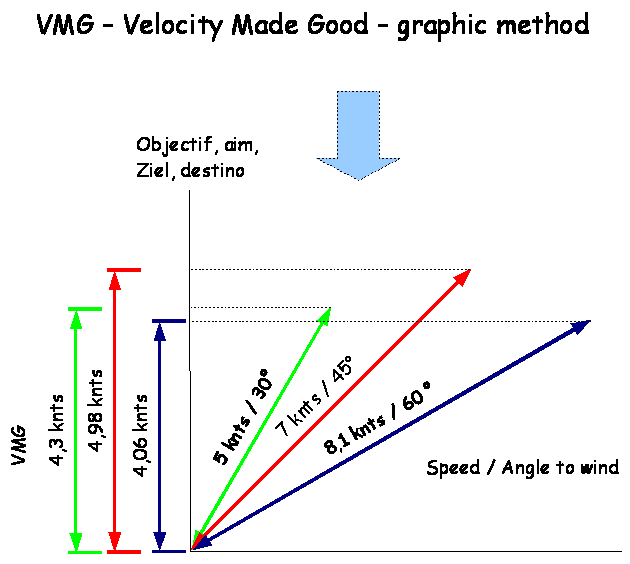
When you beat towards a point to windward, VMG (Velocity Made Good) gives your speed of approach to the objective. That is what counts, not speed through the water: it is the best compromise between heading and speed.
Checking that a trim change helps
Close-hauled, two questions: has my speed gone up? Has my heading improved? Compare the log speed (speed through the water, excluding tidal stream) before and after the change, and the heading achieved, which you should note before touching anything. As for the maths, VMG equals cosine of the angle to the wind × speed over the ground: at 30° to the true wind, cos(30) ≈ 0.86, so 0.86 × 5 knots = 4.3 knots of approach.