The principle: stay as close as possible
Here is a technique under genoa, the quick stop, and one under symmetric spinnaker. In both cases the idea is the same: never move away from the person in the water. The basic rules on board (lifejacket, harness, jackstays) are on the Life on board page.
Under genoa: the quick stop
How the manoeuvre works
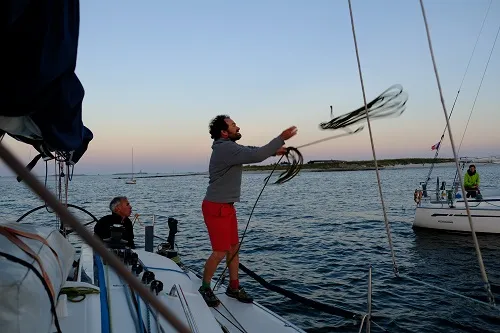
Come up almost head to wind, sheet the sails in and let the boat turn: she stays very close to the person in the water. With the sails sheeted in there is no danger, and it gives you time to get organised — to stop the turn head to wind and drop the sails, or, if you are alone on board, to start by pressing the MOB button on the GPS, throwing a lifebuoy and sending a MAYDAY if the situation looks difficult.
A real recovery, analysed
- Mel, an Englishman, on the helm, started the turn almost immediately. He could have waited two seconds longer. The Bavaria Match turn almost on the spot, but not every boat does: take care not to hit the person in the water with the boat!
- José took in the genoa sheet as soon as the genoa flogged; Hana was ready to take in the mainsheet: everyone had understood their role.
- Hana let the halyards go at the right moment, and Mel held the boat head to wind while the sails came down. José then went forward to drop the genoa.
- The manoeuvre was done without a genoa furler or lazy jacks, and it works! Note that with a self-tacking jib, the boat turns far less well: that kind of equipment is pure marketing, not efficient and safe sailing.
- The manoeuvre took under 3 minutes, and it was reassuring for Aurélien, in the water, to see the boat close by the whole time.
Under spinnaker
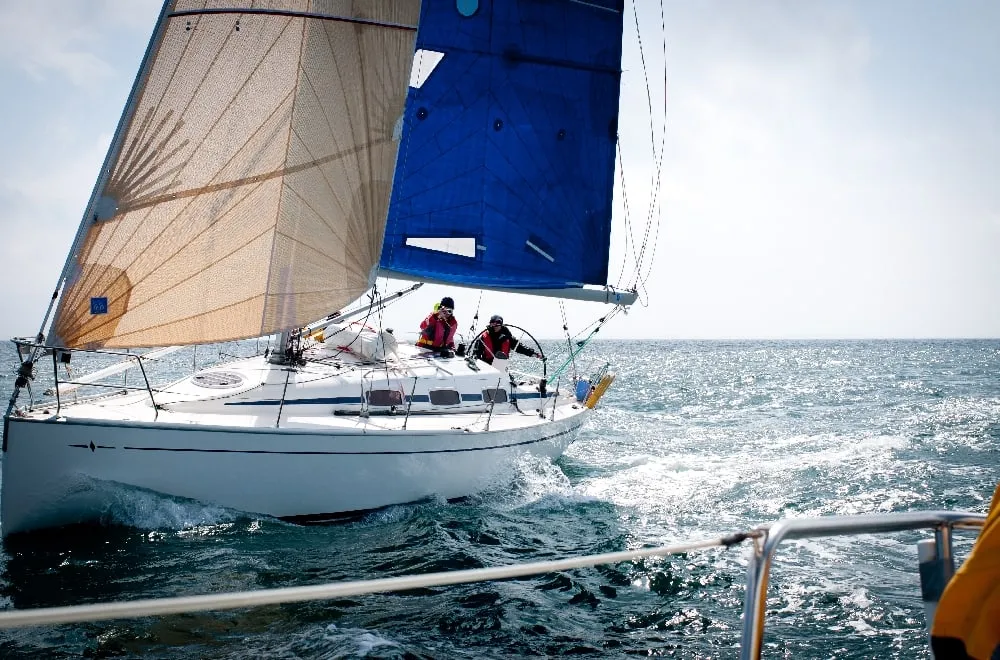
As with the previous manoeuvre, the idea is to stay as close as possible to the person in the water. Despite the spinnaker, Hana brings the boat head to wind almost instantly.
- In this round-up, it is essential to let go the spinnaker guy, so that the tack of the spinnaker is freed and can swing to leeward.
- As soon as possible, the engine is started and the boat kept head to wind.
- Then you simply gather in the spinnaker sheet, control the drop with the halyard and bring the spinnaker into the cockpit.
- The mainsail can then be dropped and the person recovered.
It took 4 minutes to recover Aurélien, and the boat stayed close by throughout.
The crew debriefing
After the manoeuvre, the crew talks it through together, calmly: what each person did, what went well and what can still be improved.
Towing under sail
A boat with engine failure can be taken in tow by another. The boat being towed is best kept under sail, preferably headsail, so she stays manoeuvrable.
Getting a grounded boat off
When a boat has run aground, you pull at right angles to her, on a masthead halyard: she heels, her draught decreases and she can come free. This is how Taranta and German sailors got a Class 40 off in Port-Louis.
Setting off the life raft
Knowing where the life raft is and how to set it off is part of safety on board. As the video shows, you have to pull hard!