The principle: finding your bearings from the wind
A point of sail is the angle between the boat's course and the direction the wind is coming from. You start head to wind (bow pointing straight into the wind) and turn the boat away step by step: each step has its own name, its own sail trim and its own feel. Learning the points of sail is a necessary step to find your bearings, even if, in practice, fine sail trim depends above all on the boat's speed and the state of the sea (see the page Sail trim).
There are two broad families: the upwind points of sail (the wind comes from ahead, you sail up towards it) and the downwind points of sail (the wind comes from behind and pushes). In between, the beam reach is the transition.
The no-go zone
No sailing boat can sail straight into the wind. In a sector of 35 to 45° either side of the wind direction, depending on the boat (a classic cruiser hardly points higher than 45°; our cruiser-racers have their best upwind VMG at about 37° to the true wind in 16 knots) — the no-go zone — the sails can only luff (flap like a flag): they get the wind on both sides, no longer fill and no longer drive. The boat slows down, stops, then starts going backwards.
That is why you cannot reach a point dead to windward in a straight line: you have to beat towards it in a zigzag, staying just on the edge of this forbidden zone.
Points of sail, from close-hauled to a dead run
From closest to the wind to furthest away:
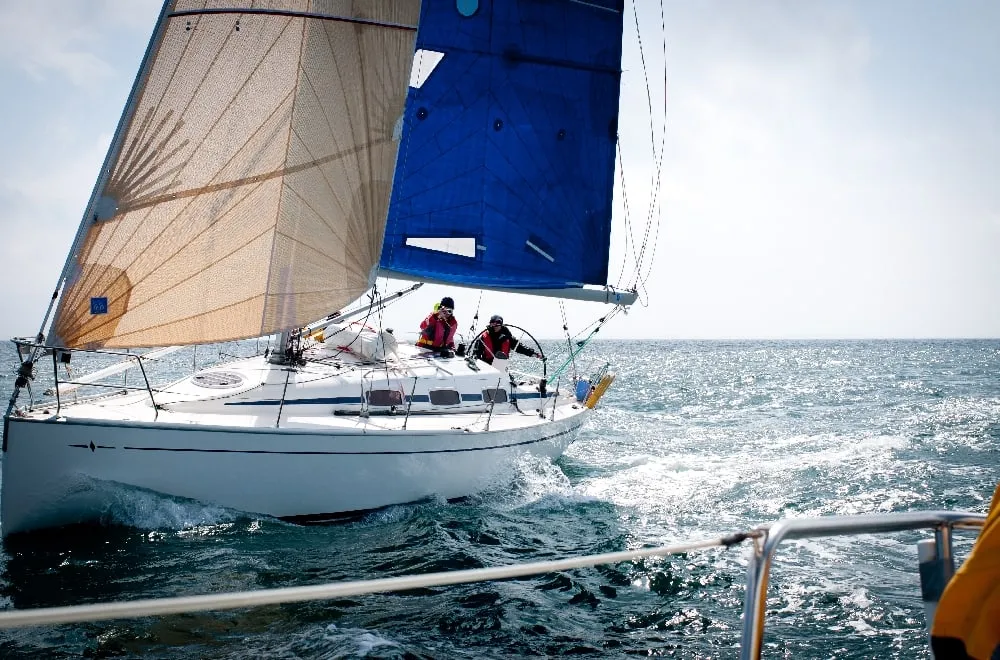
- Close-hauled (≈ 37 to 45° to the true wind, depending on the boat) — the closest to the wind the boat can hold. You are sailing up into the wind, the boat heels and slams into the waves, the sails are sheeted in hard. The point of sail of performance and patience.
- Close reach (≈ 60°) — you have borne away slightly (turned the bow away from the wind) compared with close-hauled. The boat is faster, less weather-helmy and more comfortable: often the best point of sail for making real progress upwind without wearing yourself out.
- Beam reach (≈ 90°) — the wind comes at right angles to the boat's centreline. A fast, balanced and easy point of sail: the sheets are half eased, the heel is moderate. The cruising point of sail par excellence.
- Broad reach (≈ 120°) — the wind comes from abaft the beam. The boat runs fast and comfortably, without heeling much; the sails are well eased.
- Very broad reach (≈ 150°) — the wind comes clearly from behind. The queen of the downwind points of sail; you can hoist the spinnaker. The mainsail is well out.
- Dead run (≈ 180°) — the wind pushes from directly astern. A point of sail that looks easy but is full of traps: little heel, little sense of speed, and the risk of an accidental gybe if the boat bears away too much. The mainsail is fully eased on one side, the genoa is often blanketed (you can sail “goose-winged”, setting the two sails on opposite sides).
Heading up and bearing away
Two verbs to know by heart. Heading up (coming up, pointing higher) means bringing the bow closer to the wind (towards close-hauled). Bearing away means turning the bow away from the wind (towards a run). Helming is all about balancing the two according to the course you want and the boat's balance.
Which point of sail is the fastest? It depends on the wind strength. On our boats it is around 75° to the wind in light airs (4 knots) and around 135° in strong wind (24 knots).
This diagram is not for trimming the sails. The angles of the rose are measured from the true wind. But you trim the sails to the apparent wind, whose angle depends a great deal on the boat's speed: see sail trim.
True wind, apparent wind & VMG, in brief
The true wind is the wind felt by a stationary observer. But once the boat is moving, its own motion creates a boat-speed wind (like the headwind you feel on a bicycle, even on a calm day). The two together give the apparent wind: it, and it alone, is what actually blows into the sails, and what you trim to.
The practical consequence: the faster the boat goes, the more the apparent wind strengthens and moves forward. Upwind, you therefore need to sheet in harder than you might think; downwind, on the other hand, the apparent wind drops. That is why the same angle to the true wind does not call for the same trim at different boat speeds.
VMG: making progress in the right direction
When you beat towards a point to windward, pure speed through the water does not tell the whole story: what counts is VMG (Velocity Made Good), the actual speed at which you close on your objective. Pinching (sailing too close to the wind) improves your heading but kills your speed; bearing away too much gains speed but lengthens the route. The best VMG is the best compromise between heading and speed.
Changing tack: tacking or gybing
To bring the wind from one side of the boat to the other (to change tack), there are two manoeuvres, depending on your starting point of sail:
- Tacking — you turn the bow through the wind, crossing the no-go zone. The manoeuvre of the upwind points of sail: you head up, the genoa crosses to the other side, and you sheet it in again on the new tack. A smooth manoeuvre with no jolt, which above all needs enough way on to cross the no-go zone without stopping.
- Gybing — you turn the stern through the wind, via a dead run. The manoeuvre of the downwind points of sail. The mainsail swings violently from one side to the other: you must sheet it in before it crosses and then let it run out under control, or risk a crash gybe (dangerous for the crew's heads and for the rig).
When do you do one or the other? To make progress upwind, you tack again and again (you beat to windward). To sail down to an objective to leeward, you gybe again and again. The choice is not a matter of preference: it depends on where the objective lies relative to the wind.