Many tense situations could have been foreseen and avoided. But they do happen: what matters then is to stay calm, know which rule applies, and manoeuvre early and decisively.
1. Sailing boats on opposite tacks
Two sailing boats have the wind on different sides (one on port tack, the other on starboard tack).
The rule
A boat on port tack must keep clear of a boat on starboard tack. The boat on starboard tack (the one with the wind coming from the right) is the stand-on vessel and holds her course.
As a reminder: starboard tack = the wind comes from the right (from starboard); port tack = the wind comes from the left (from port). The tack names the side the wind is coming from.
2. Sailing boats on the same tack
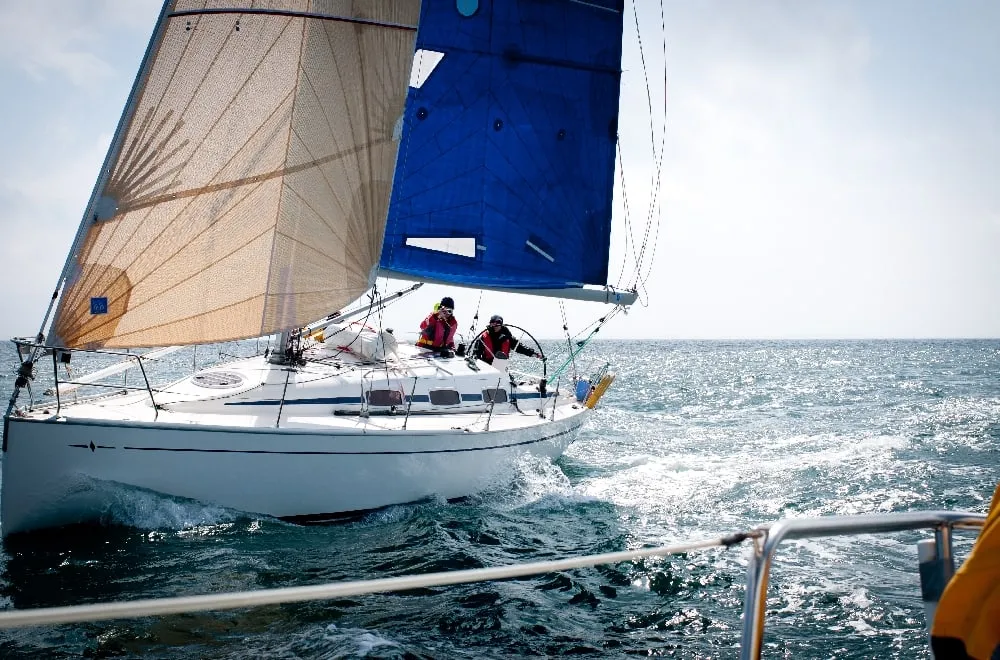
Both sailing boats have the wind on the same side (same tack). It is then their position relative to each other that decides.
The rule
The windward boat must keep clear of the leeward boat. The leeward boat — the one on the side away from the wind, whose wind the other can blanket — has right of way.
3. Overtaking
One sailing boat comes up on another from astern, whatever tacks they are on.
The rule
The overtaking boat must keep clear of the boat being overtaken. The overtaking boat must pass well clear, without hindering the boat she is passing.
In short
- Opposite tacks → port tack gives way to starboard tack.
- Same tack → the windward boat gives way to the leeward boat.
- Overtaking → the overtaking boat gives way to the boat being overtaken.
- The stand-on boat holds her course as long as there is no absolute need to manoeuvre — so as to stay predictable.
When in doubt, keep clear
Every vessel has a duty to avoid a collision, including the vessel that has right of way. Right of way never entitles you to charge ahead: if the situation is confused, if the other boat is not manoeuvring, if you are not sure who has right of way — anticipate, slow down, keep clear. Safety always comes before “right of way”.
These are the rules of COLREGs (rules 12 and 13), which racing takes up in a similar form. When several boats are involved, they combine: a boat may have to keep clear of a leeward boat and give way to a starboard-tack boat at the same time. The right response — heading up, bearing away decisively, luffing head to wind to slow down, or tacking — depends on the room available and on what the others are doing. Manoeuvre early, communicate clearly, leave room.