Many of our trainees come to us with a clear goal: to log the miles they are missing before applying for an offshore licence. This is particularly true of German and Swiss candidates, whose licences require a set number of miles sailed at sea, certified by the skipper.
This page answers the three questions we are asked most often: how many miles you need, how many you sail here, and how you prove them.
Why “certified” miles
An offshore licence is not just a matter of passing the theory exam. The authorities also ask for real sea experience, expressed in nautical miles sailed on board a sailing yacht and certified by the person in command of the boat.
So these are miles you earn by actually sailing: not at anchor, not alongside a pontoon. Hence the very practical question candidates ask themselves — how many miles will I really sail this week?
How many miles each licence requires
Orders of magnitude, for guidance only:
| Licence | Miles usually required |
|---|---|
| SKS — Sportküstenschifferschein (Germany, coastal) | about 300 miles |
| SSS — Sportseeschifferschein (Germany, coastal waters up to 30 miles) | in the region of 1,000 miles (fewer if you already hold the SKS) |
| Swiss offshore licence (Hochseeausweis) | in the region of 1,000 miles, over a minimum number of days at sea; 300 of them can be sailed before the theory exam |
Always check the exact figure with the authority that issues your licence (DSV / DMYV for Germany, the CCS / Swiss Maritime Navigation Office for Switzerland) before booking: these requirements change, and some come with extra conditions — minimum passage length, how recently you passed the theory exam, a share of night or offshore sailing. We are happy to help you take stock before you choose your week.
Why Brittany earns you more miles
This is our real advantage, and there is nothing commercial about it: it is geographical.
Brittany has a large tidal range, and therefore strong tidal streams. A well-prepared passage uses these streams instead of fighting them: you set off at the right time for the tide, ride the favourable stream, and make much faster progress over the ground. For the same wind and the same time at sea, you therefore cover more miles here than in the Mediterranean.
It is also an excellent school: learning to work with tidal streams is exactly what is expected of a skipper in tidal waters.
Then there is the wind: Brittany offers good wind conditions throughout the season. That all but guarantees you log your miles under sail, not under engine — and without being stuck in harbour.
How many miles with us
Our honest orders of magnitude:
- Classic coastal cruising course week: in the region of 30 to 40 miles a day, depending on the programme and the ports of call.
- Miles-building course: the aim is 250 miles over the week, with legs of 60 to 70 miles on some days, while still sleeping in harbour at night.
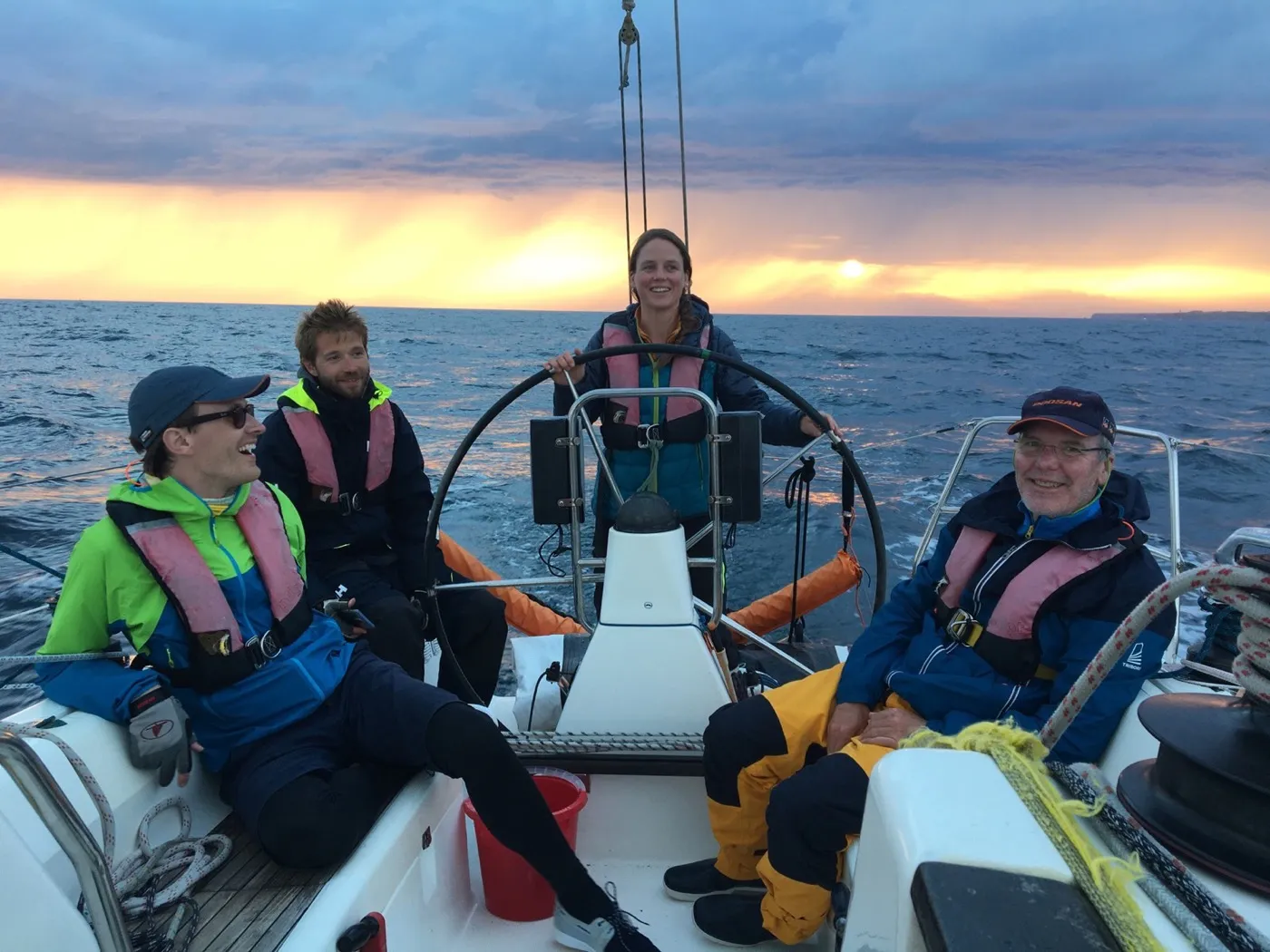
- Offshore passage: legs are counted in hundreds of miles, with night sailing and watches — the fastest way to build up your total, and the best training for the open sea.
These are targets, not guarantees: the weather is in charge. We do our best to reach them, and at the end of the week we tell you frankly where you stand.
An important point: the miles remain fully valid even when the week includes coastal sailing and ports of call. You do not have to choose between logging miles and learning to sail.
The certificate
At the end of the course, the skipper issues a certificate of miles: dates, sailing area, distance sailed, boat, and the professional skipper’s signature. This is the document the authority issuing your licence asks for.
Tell us before departure that you are sailing to qualify for a licence, and which one: this lets us adapt the week’s programme — more continuous sailing, a night at sea if useful — and fill in the certificate with what your authority expects.
Miles-building course for the Swiss offshore licence
Brittany and the school bring together everything you need to log your miles efficiently, intelligently and in comfort.
The skippers. Gaëlle and Loïck are both state-qualified skippers, highly experienced professionals. They are responsible for the safety of the course, the performance of the boat and a high standard of teaching. They have already certified the miles of many candidates for the Swiss offshore licence (Hochseeausweis), on the CCS forms (Cruising Club der Schweiz).
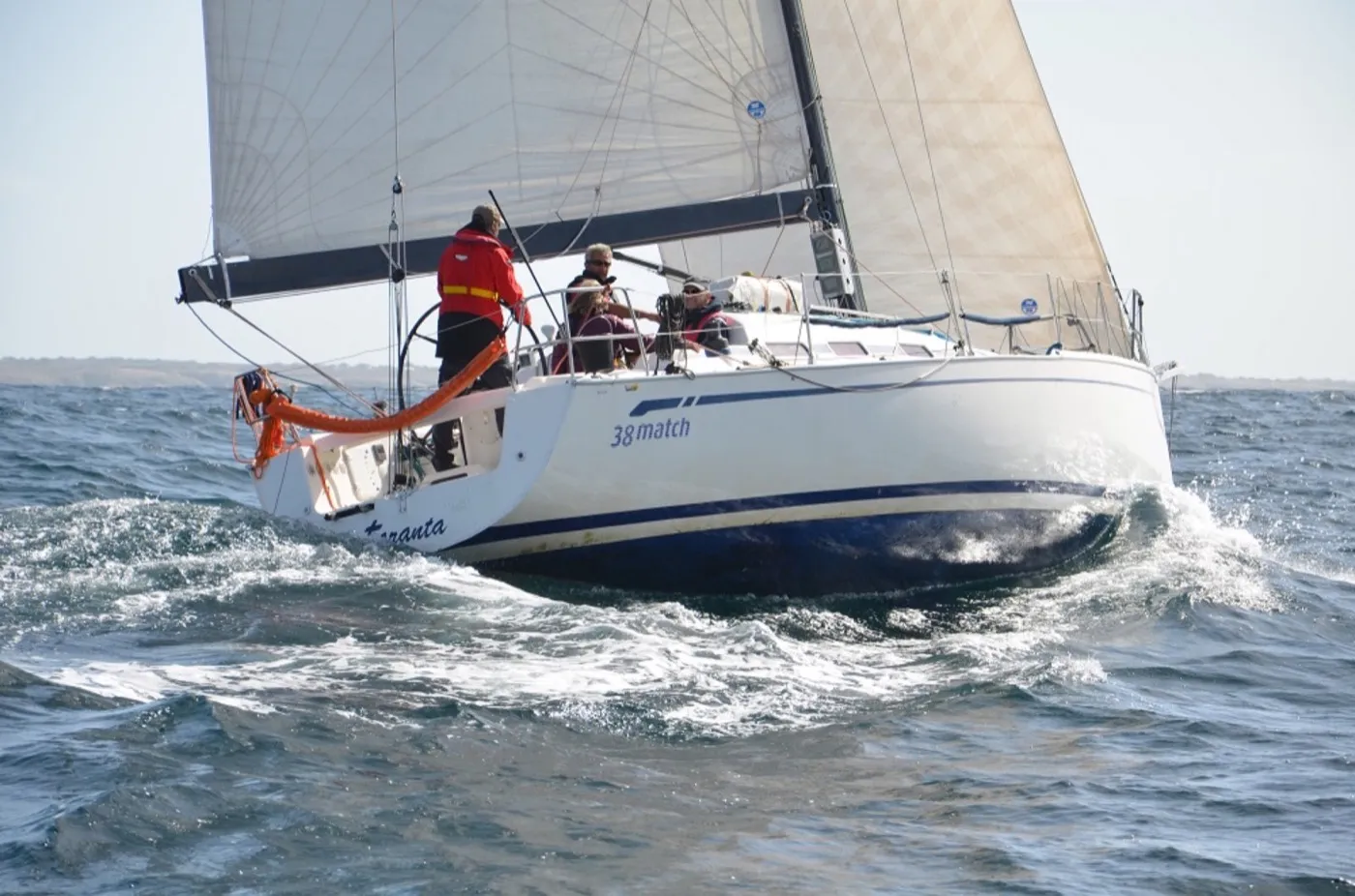
The boat. Your miles-building course is sailed aboard Perseus, a Bavaria 42 Match: tall carbon mast, more than 100 m² of sail upwind, a 115 m² symmetric spinnaker on a carbon pole, an asymmetric spinnaker and a code 0, with a 2.45 m draught. She is very comfortable for 6 people. Her average speed is high — 8 knots cruising: in the same sailing time, you cover about 20% more miles than on a cruiser such as a Bavaria Cruiser, Oceanis or Sun Odyssey.
Enjoyment too. Our cruiser-racers are real pleasure boats and real training boats: the joy of the big wheel, the interest of sail trim, the feeling of speed. You build your miles while enjoying yourself and carrying on with your technical training.
Miles that really teach you. With no more than 5 trainees on board, everyone gets as much helming time as possible. You take part in harbour manoeuvres and in passage planning.
Which courses? The miles-building course and the offshore passages are the opportunities to log these miles (see below).
Price: 760 € for the miles-building course.
Dates: on request, until they are in the calendar. Write to us with your possible dates, or see how to sign up.
Which course to choose
- You need a lot of miles quickly → the miles-building course, or an offshore passage.
- You want miles and training → the coastal cruising course, stating your goal when you book.
- You are preparing for the SKS and want to work on manoeuvres → combine it with a week of harbour manoeuvres.
The simplest thing is to write to us stating the licence you are preparing for, the number of miles you are missing and your possible dates: we will tell you frankly which week fits, or whether you need two.